History
Why the Votivkirche exists
How an 1853 attack on Emperor Franz Joseph led to the Votivkirche: the donations, the competition won by Ferstel, the 1879 consecration and the rebuilding.
Book Light of Creation ↗Quick answer
The Votivkirche was built as a thank-offering after János Libényi tried to stab Emperor Franz Joseph on 18 February 1853. Heinrich von Ferstel won a competition of 75 entries, construction began in 1856, and the church was consecrated on 24 April 1879, the silver wedding anniversary of the imperial couple.
18 February 1853
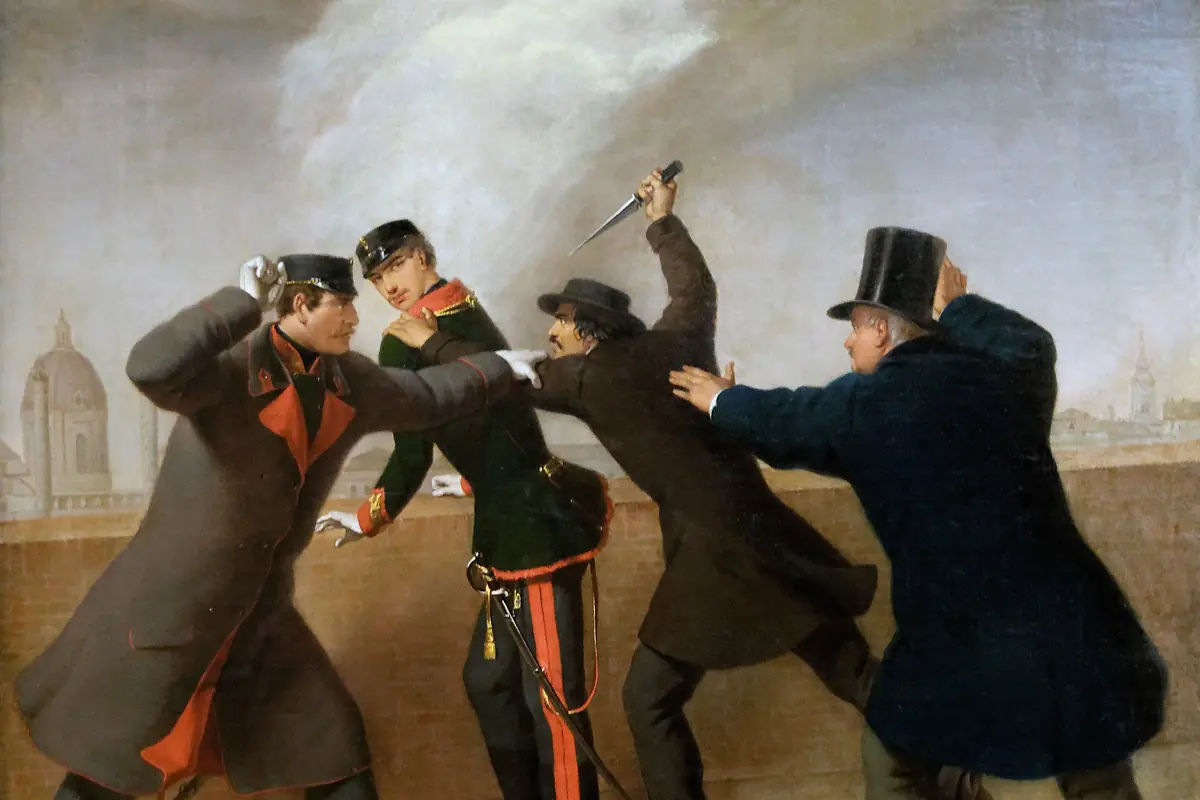
On 18 February 1853 a tailor by trade named János Libényi attacked the young Emperor Franz Joseph from behind with a long knife. According to English Wikipedia, the blow was deflected by the stiff, embroidered collar of the Emperor's uniform, and he was left with a deep wound but survived. Count Maximilian O'Donnell struck the attacker with his sabre and held him until police arrived, and a civilian, Joseph Ettenreich, helped the Emperor and was later ennobled for it. A painting made in the same year shows the struggle.
A church as a thank-offering
The Emperor's brother, Archduke Ferdinand Maximilian, later Emperor of Mexico, called for donations for a church that would give thanks for the Emperor's rescue. The parish's own history says about 300,000 citizens contributed. The idea was a monument to loyalty as much as to faith: a votive church, which is what Votivkirche means, paid for by the people of the empire. That origin explains the building's ambition: a church meant to be seen as a gift from the whole empire. English Wikipedia describes it as a monument of patriotism and of the people's devotion to the Imperial House.
Seventy-five designs
A competition was announced in April 1854, and the jury received 75 entries from the Austrian lands, the German states, England and France. It chose the design of Heinrich von Ferstel, who was 26 at the time. He proposed a neo-Gothic church modelled on the French cathedrals. Ferstel went on to design the main building of the University of Vienna, built in 1871–84 according to Wikipedia, which stands near the church today. His career belongs to the same building boom on the Ringstrasse. Ferstel was born in Vienna on 7 July 1828 and died on 14 July 1883, only four years after the church was consecrated.
Built between 1856 and 1879
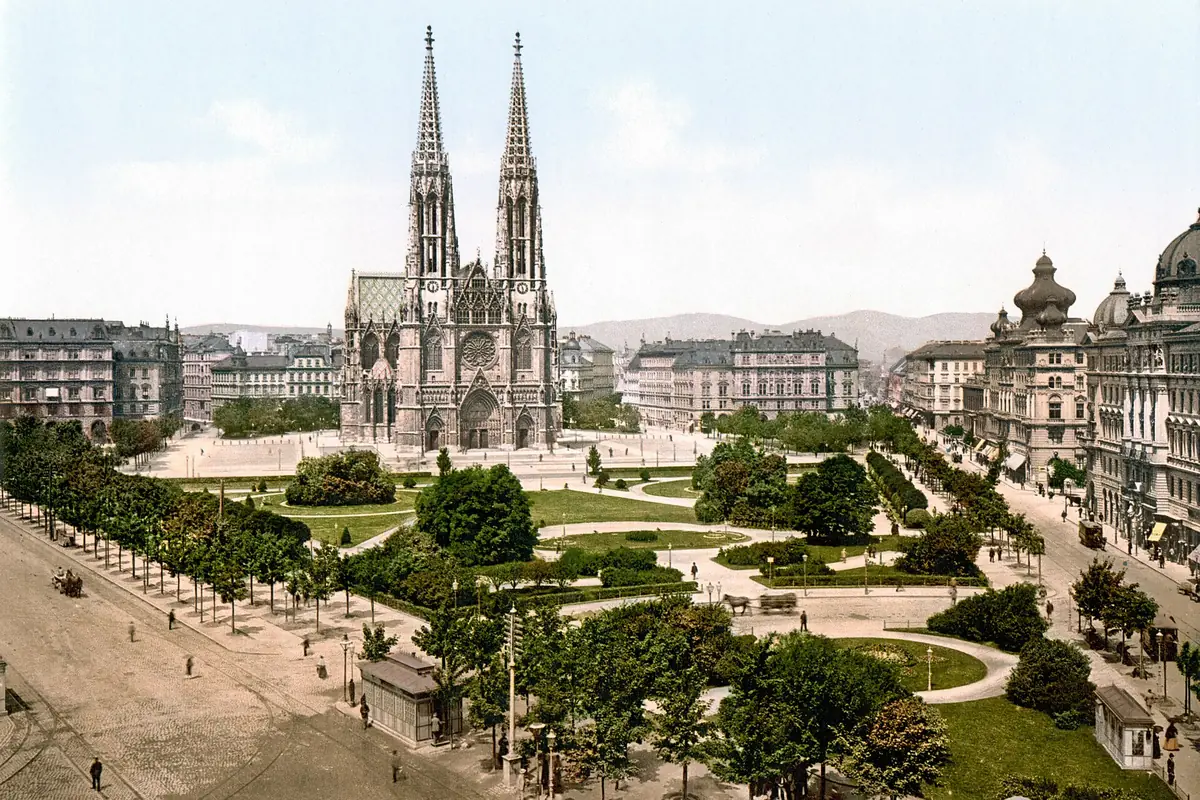
Construction began in 1856 and took 23 years. German Wikipedia says the foundation stone was laid by Franz Joseph and Cardinal Rauscher, and that the stone came from the Josaphat valley in Jerusalem. The towers reached their full height of 99 metres on 18 August 1868, and the church was consecrated on 24 April 1879, the silver wedding anniversary of Franz Joseph and Empress Elisabeth. It became a parish church the following year. According to English Wikipedia it is 85 metres long and 55 metres wide, with a nave 30 metres wide. A photochrom print from about 1900 shows it standing on an open square with its twin towers.
War damage and a long restoration
English Wikipedia says the church was badly damaged in the Second World War. The German article adds that it originally had 78 stained-glass windows, that many were destroyed, and that the restoration of 1960–1973 mostly produced new designs. The pale stone also suffers from weather and air pollution, which is why the building has needed work almost continuously. The Emperor window, a gift of the City of Vienna, originally showed the Emperor's rescue; that window was destroyed in the war, and its replacement of 1964 is more religious in tone. German Wikipedia reports a restoration of about 25 years that ended with a High Mass on 26 November 2023, so the stonework you see has been restored recently.
A tomb and an altar
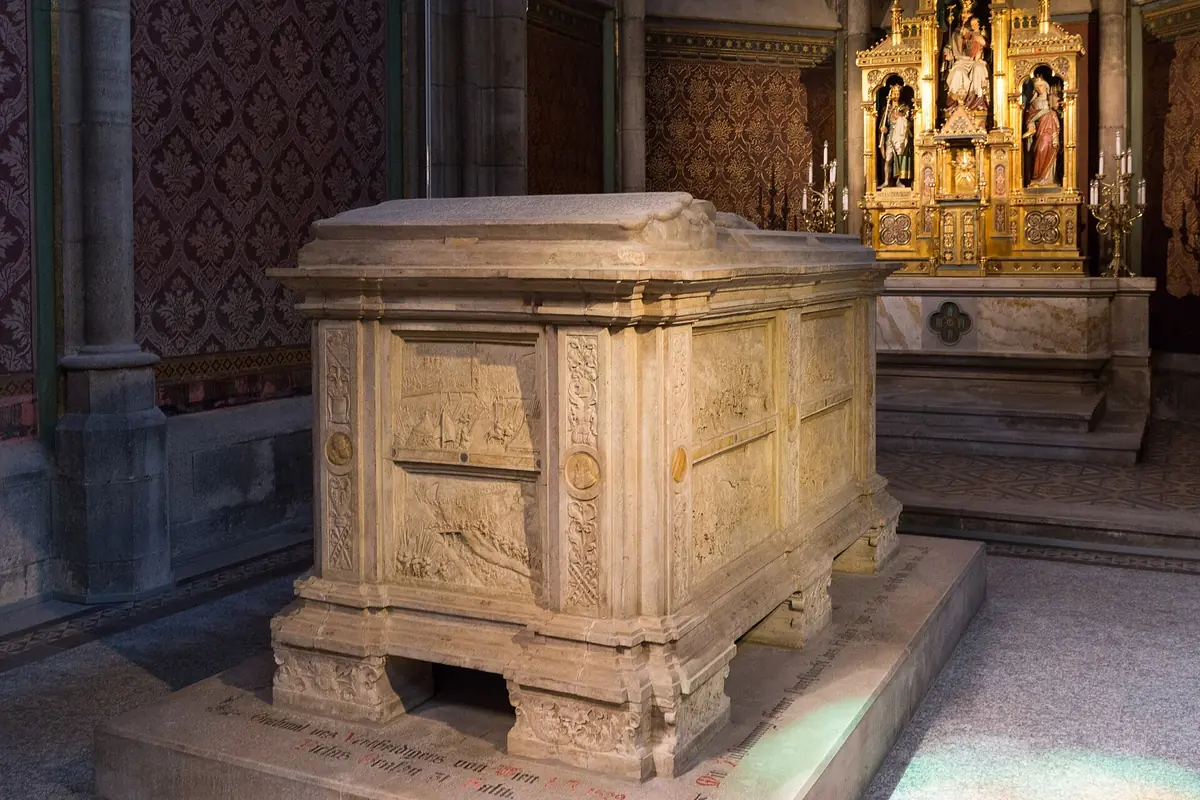
Inside, the Salm tomb belongs to Count Nicholas of Salm, who at the age of 70 organised the defence of Vienna during the Ottoman siege of 1529. A falling rock wounded him, and he died on 4 May 1530. The tomb sculpture is by Loy Hering and, per German Wikipedia, is shown in the Rosary chapel on loan. The late-15th-century Antwerp altarpiece is a Flemish woodcarving kept in the church's museum. Today the nave also hosts the Light of Creation show, which uses the same architecture as its screen.
Read next: Light of Creation: booking
Frequently asked questions
Who designed the Votivkirche?
Heinrich von Ferstel, who was 26 when his design won the 1854 competition of 75 entries.
When was it consecrated?
On 24 April 1879, the silver wedding anniversary of Emperor Franz Joseph and Empress Elisabeth.
Was the Emperor badly hurt in 1853?
He was wounded but survived. Sources say the blow was deflected by his collar.
How tall are the towers?
The towers reached 99 metres in 1868, according to German Wikipedia.
Sources